Company news
The Last Line of Defense: Why Physics Must Defend Our Data Against Autonomous AI
October 30, 2026 · The HyperBUNKER Team
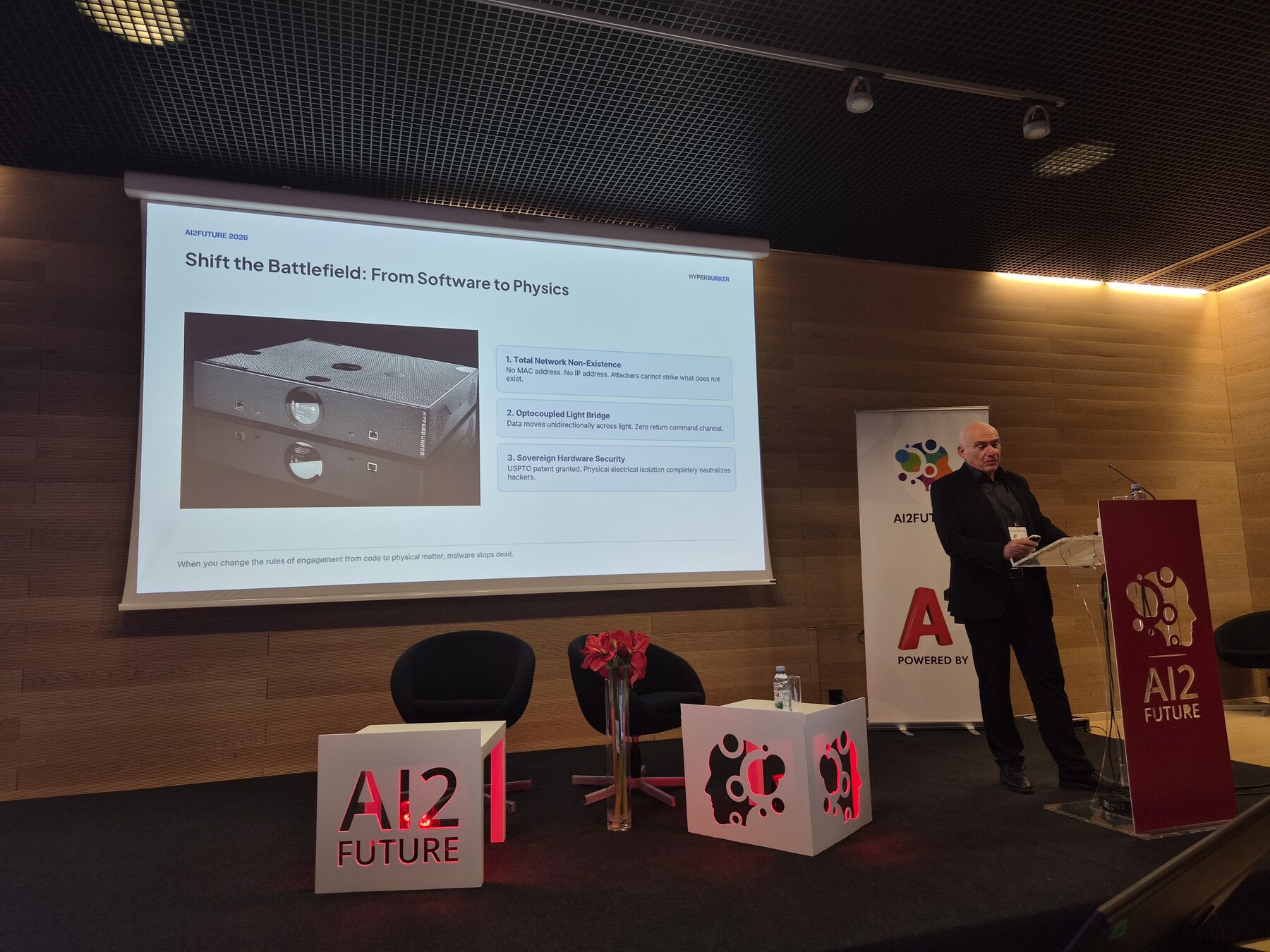
At the recent AI2FUTURE conference in Zagreb, the atmosphere across the technology stages buzzed with discussions on model efficiency, generative applications, and autonomous multi-agent frameworks. Yet in the Business and Implementation presentation room, HyperBUNKER brought forward a vital, sobering counterweight to the prevailing enthusiasm.
Our Inventor, Founder, and CTO, Imran Nino Eškić, delivered a packed 30-minute keynote titled: "Cybersecurity & AI: Last line of defense for your data, Why software cannot defend against autonomous AI, and why true resilience is anchored in the laws of physics."
Addressing business leaders, engineers, and digital architects, Imran challenged the fundamental assumptions underpinning contemporary cybersecurity. His message was direct: in a world where autonomous machine intelligence operates at algorithmic speed, defending software with more software is a failing proposition.
Twenty-Five Years and 50,000 Real Security Crises
Imran Nino Eškić did not approach the podium from an academic ivory tower. With a career spanning over 25 years in data recovery, digital forensics, and hardware recovery, he has personally investigated and resolved more than 50,000 real-world security breaches, critical hardware collapses, and catastrophic data loss incidents.
When organizations suffer total operational failure, forensic engineers like Imran see what standard telemetry misses: the harsh truth of how software defenses crumble when attacked by determined adversaries. Over two and a half decades, the pattern has remained constant. Attackers evolve, attack surfaces widen, yet organizations continue to layer fragile digital code over flawed legacy systems, expecting a different outcome.
The arrival of autonomous AI agents has pushed this systemic vulnerability past the point of no return.
The Software Paradox in the Era of Autonomous AI
During the presentation, Imran dissected why traditional cybersecurity stacks, firewalls, endpoint detection and response (EDR), Security Information and Event Management (SIEM) systems, and software access policies, are structurally incapable of stopping next-generation autonomous exploits.
Software is dynamic, mutable, and governed by logic that executes in shared memory spaces. An autonomous AI agent does not suffer from human latency. It does not sleep, hesitate, or make manual configuration errors. It can identify zero-day vulnerabilities, rewrite exploit payloads in milliseconds, simulate administrative credentials, and poison digital audit trails faster than any human SOC team can analyze an alert.
When autonomous code attacks defensive code, the outcome is dictated by computational asymmetry. If your last line of defense exists purely as software instructions stored on alterable rewritable media, that defense can always be subverted, corrupted, encrypted, or wiped. Adding another AI-powered monitoring software on top simply expands the digital attack surface.
Anchoring Resilience in the Laws of Physics
The core breakthrough shared during the Business and Implementation session is HyperBUNKER’s founding philosophy: when software logic can no longer be trusted, resilience must be anchored in the immutable laws of physics.
Physics does not rely on credentials, zero-trust tokens, or algorithmic validation. An electrical state cannot bypass physical disconnection. A laser beam cannot un-burn an optical mark on an immutable medium. A microscopic circuit break cannot be bypassed by an API prompt injection or social engineering.
Eškić illustrated how HyperBUNKER re-engineers data survival from the physical foundation up
True Physical Air-Gapping: Creating unbridgeable structural barriers that no network packet, remote zero-day exploit, or lateral autonomous agent can cross.
Deterministic Write-Once Hardware: Enforcing physical irreversibility, ensuring that once mission-critical data, intellectual property, or baseline system configurations are committed, no software command, privileged or compromised, can ever alter or encrypt them.
Environmental and Structural Hardening: Protecting corporate continuity against severe operational shock, localized electromagnetic events, and systemic digital blackout.
By shifting the final defense layer from lines of code to the laws of physical matter, organizations eliminate the computational advantage possessed by hostile AI.
The Takeaway for Enterprise Leaders
The reception within the Business and Implementation room made one truth unmistakable: executives and security leaders are actively seeking solutions beyond standard recurring software subscriptions. The era of blind faith in purely digital safeguards is drawing to a close.
As autonomous systems take over critical workflows, sovereign enterprises must determine what their ultimate fallback looks like. When all networks are severed and every software layer is under contention, where does your critical data actually live?
At HyperBUNKER, we are proud to see Imran Nino Eškić leading this essential conversation on European stages. True data resilience is not an algorithm, it is an absolute physical reality.
To discuss HyperBUNKER’s sovereign infrastructure solutions or to schedule an operational briefing with our engineering team, feel free to reach out to nino@hyperbunker.com.