Company news
When Prevention Fails: How to Ensure Your Business Keeps Running
October 19, 2026 · The HyperBUNKER Team
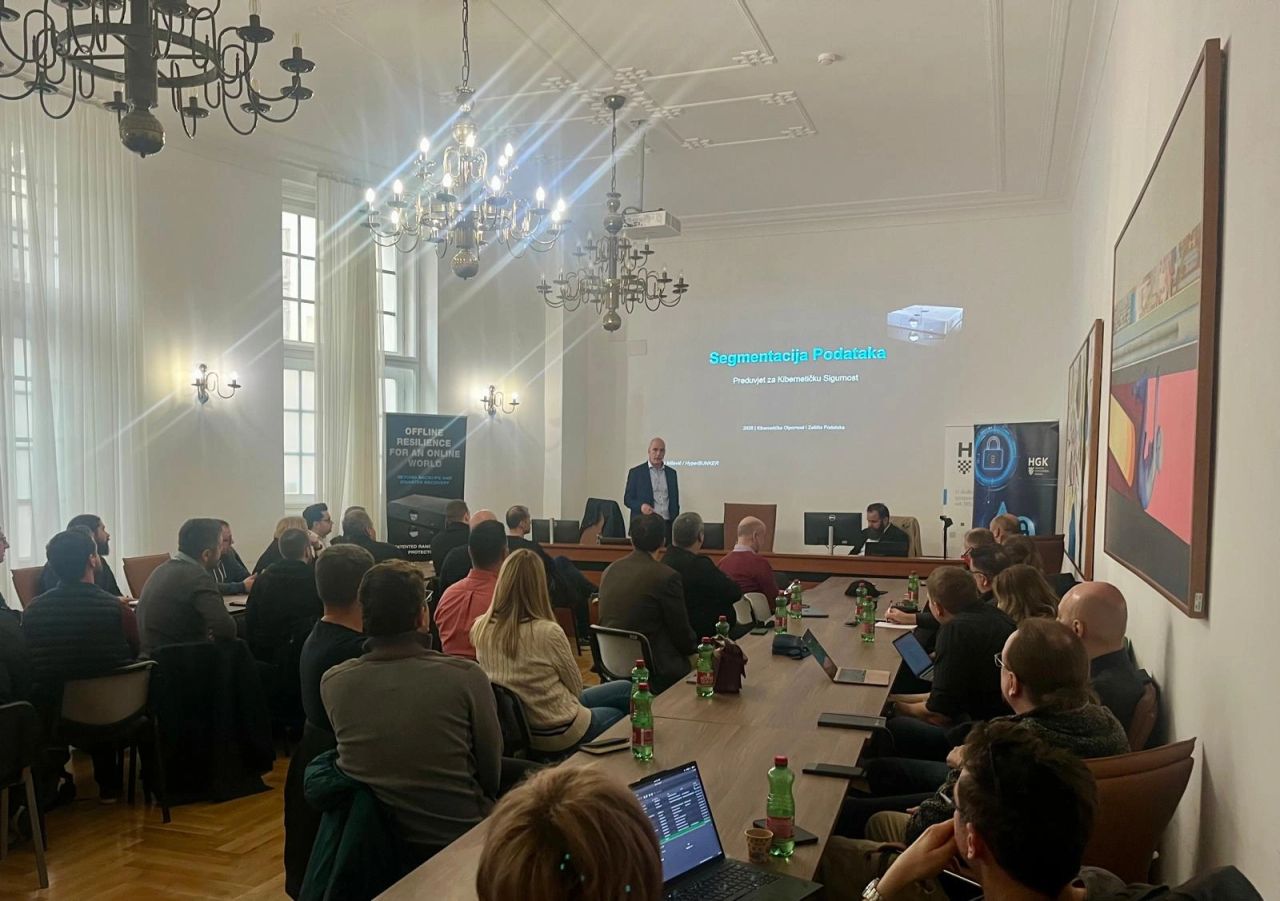
Cyber resilience boils down to a single, uncompromising question: Can your organization continue to operate when something goes seriously wrong?
When addressing leaders and professionals at the Croatian Chamber of Economy’s Cyber Security Academy (Akademija kibernetičke sigurnosti HGK), the discussion intentionally steers clear of dry regulatory checklists and abstract theory. Compliance alone does not survive contact with an active breach. Instead, the focus rests on the brutal, practical questions every executive team must be prepared to answer:
What is our truly critical data?
What happens to our business operations if that data vanishes overnight?
How many hours or days can we realistically survive without access?
Have we ever actually tested a full system restore under realistic pressure?
Collaborating within the Academy alongside Marko Gulan brings immense value to this mission. Marko understands cybersecurity through the dual lenses of evolving regulations and technical infrastructure, but always grounded in real-world business impact, risk exposure, and actionable readiness. Sincere gratitude is also due to Tajana Kesić Šapić for her ongoing trust, vision, and steadfast support in recognizing the vital necessity of this program within the HGK framework.
The Fixed Mindset Trap vs. The Growth Mindset in Security
Navigating modern threats demands a fundamental shift in philosophy, a Growth Mindset.
An organization trapped in a fixed mindset rests on passive assumptions: “We have backups in place, so we are secure.” This false sense of safety is often shattered only when disaster strikes.
An organization driven by a Growth Mindset approaches the problem with relentless curiosity and rigor: “What concrete evidence do we have that our backups will actually restore cleanly and swiftly when everything is on the line?”
A growth-oriented team does not wait for an adversary to expose their blind spots. They test regularly. They trigger intentional, controlled failures, pinpoint vulnerabilities before an attacker does, refine their workflows, and test again. Uncovering a flaw in a scheduled drill costs time and effort; uncovering it during a live ransomware extortion costs millions, reputation, and sometimes the business itself. Controlled experimentation is infinitely cheaper than ransomware tuition.
When an IT Incident Becomes an Executive Crisis
There is a persistent, dangerous misconception that cybersecurity is strictly an IT department responsibility.
While an incident often manifests first in a server log, an alert console, or an encrypted terminal, it metastasizes at lightning speed into an existential crisis of governance, brand equity, and leadership. When systems go dark, IT engineers cannot make high-stakes business determinations in a vacuum:
Which core business processes must be brought back online first?
What is the threshold of downtime before contractual liabilities destroy the bottom line?
What is our immediate communication protocol with customers, the media, and regulators?
What level of operational risk are we willing to tolerate to get systems partially functional?
These are executive decisions. Cyber crisis management is an unvarnished leadership challenge, and for forward-thinking leadership, an opportunity to demonstrate authentic organizational resilience.
Prevention Fails. Resilience Endures.
Traditional cybersecurity is built around prevention, keeping the intruder outside the perimeter. Cyber resilience, on the other hand, begins where prevention ends: it guarantees that your organization can absorb the hit, withstand the blast, and keep operating even after defenses are breached.
True operational maturity is not measured by confident presentations or certifications hanging on a wall. It is measured by whether an organization can unequivocally demonstrate, under audit and simulation, exactly which datasets will be recovered, within what strict Recovery Time Objective (RTO), and in what precise sequence following a catastrophic attack.
If you want a clear baseline of your own posture, answer this question honestly:
If a targeted ransomware attack encrypted your most critical systems tomorrow morning, precisely how long would it take your organization to resume standard operations?
If you cannot give a definitive, proven answer today, do not ignore the unease. You have simply uncovered your most urgent priority. That is what a Growth Mindset is all about: facing uncomfortable realities, learning from the gaps, and building real operational muscle before circumstances force your hand. When the going gets tough, the prepared endure.
Shattering the “Impossible” with HyperBUNKER
For years, the cybersecurity industry accepted an inherent compromise between data accessibility, zero-trust protection, and rapid recovery times. Conventional wisdom claimed that complete, instantaneous, tamper-proof recovery against sophisticated cyber extortion was technically impossible.
That compromise is now obsolete.
Through patented architecture and relentless technical innovation, Imran Nino Eškić and the HyperBUNKER engineering team have delivered true disruption to the cyber resilience landscape. By solving the structural vulnerabilities of traditional recovery workflows at the root level, HyperBUNKER has turned what was once considered mathematically and operationally impossible into an automated, air-tight standard.
The threats targeting modern infrastructure are evolving daily. Safeguarding your mission requires moving beyond the passive complacency of simple backups and stepping into guaranteed, verifiable resilience.